
(A RANDOM SAMPLING OF) THE FALL
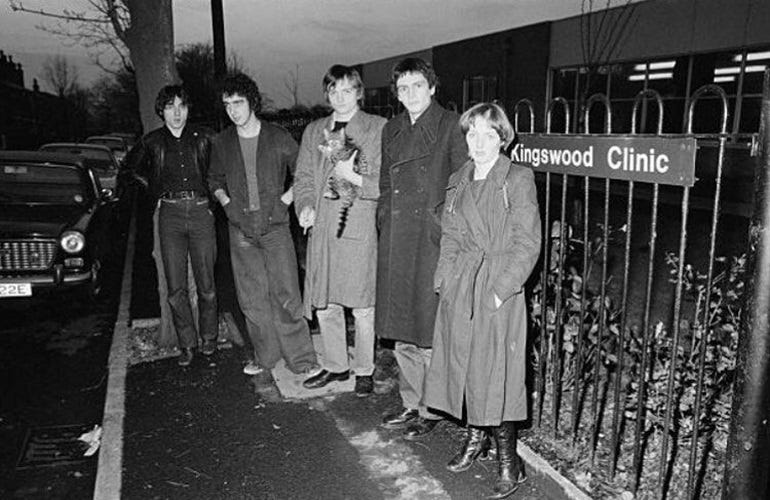
Had to do one of these for The Fall eventually, otherwise be stuck forever listening to only the first one-third of their career, beginning roughly in late 1977 when they recorded their Bingo-Masters Break-Out! EP, and ending roughly a decade later in 1989 when Brix left the band. The truth is, they were making a record almost every year and playing shows constantly for another 28 years after that, right up until Mark E. Smith passed away in 2017, and that’s too much music to ignore.
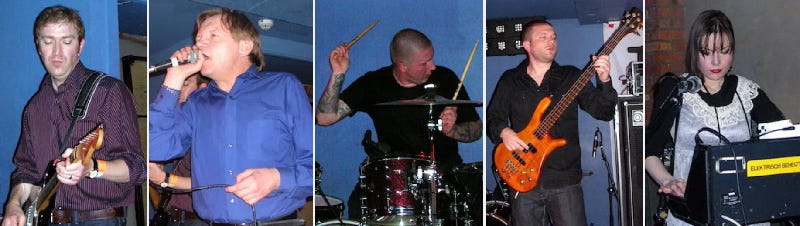
To try and wrap my brain around this sheer expanse of a career and overwhelming body of work, I’m dividing it into four periods. I’m sure some would argue with this (and here’s someone on Reddit also splitting the band into eras, more nuanced and refined than my own), but for me there’s the early raw “primal” Fall from 1977-1982 (The Fall as a punk band but mostly as a post-punk band and perhaps the greatest post-punk band of all), and then the Brix years from 1983-1989 (in which The Fall continue their post-punk reign, now with their own post-punk pop-star queen), followed by the post-Brix and increasingly-techno 90s Fall from 1990-1999, and then finally 21st Century Fall, from the year 2000 until Smith’s death in 2017, essentially the Elena Poulou years, which I’m lumping together as a single unit because Poulou was in the band and married to Smith for most of it (2002 to 2016), during which time she appeared on eight consecutive studio albums.
All of which is ultimately nit-picking, because like John Peel said, The Fall are “always different, always the same.” Nonetheless, even though I listened to the following songs in a completely random order, I’ve decided to list them here chronologically so we can see how they lay out in the context of the band’s constant static evolution. (And I promise to not make a single joke about grannies OR bongos.) Without further ado, we begin with . . .
PRIMAL FALL (1976-1982)
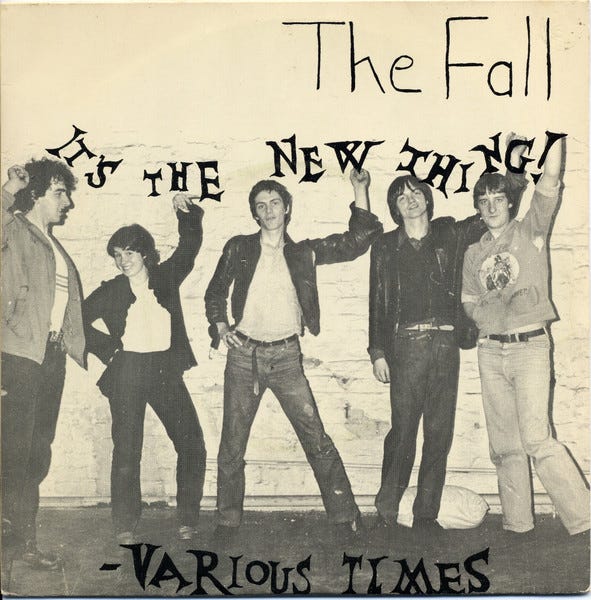
“Various Times (Extended Version)” from Live at the Witch Trials (1979, U.S. Version on I.R.S. Records). This was first released as a 45RPM B-side in November 1978 (sleeve pictured above), where it clocked in at a fairly hefty 5m14s, but this version preserves another 1m25s that was faded out for the single, giving us a 6m39s “extended version.” This longer version was also released at the time, a few months later in March 1979 on their Live at the Witch Trials debut LP, but only on the original U.S. edition. In either version, “Various Times” is a great early example of the band’s ability to extend and extrapolate and incantate through repetition (more on that later) (more on that later) (more on that later) (more on that later). Starts with a killer simple bass line by Marc Riley that is quickly doubled by Martin Bramah on guitar. Yvonne Pawlett contributes her trademark ‘great keyboards/questionable tone’ balancing act that makes the Witch Trials LP particularly unique. Then you’ve got the master extrapolators going to work, Karl Burns laying back and letting the Riley/Bramah central riff be the timekeeper so he can both drive and vary the groove, and of course Mark E, who starts the song playing a Peruvian nose flute and then with an “alright we’re gonna go BACK” goes into literary role-playing that spans distinct time periods (I guess the song is called “Various Times,” duh), from a disgruntled Nazi concentration camp guard in the first verse, to an indistinct dystopian future in the third verse, maybe even our social media-infected present, where “they got rid of time” and “time [is] mistaken/three places at once.”
“Psykick Dance Hall” from Dragnet (1979, Step-Forward). Stone classic from The Fall’s second album Dragnet, recorded in August 1979. This was Steve Hanley’s first album as bassist and Craig Scanlon’s first album as guitarist, allowing for the two-guitar lineup of Scanlon and Marc Riley, the latter moving off the bass guitar he played on Live at the Witch Trials behind now-departed sole guitarist Martin Bramah. You can sure hear how great Scanlon and Riley play guitar together on this track, one doing the greatest rockabilly riff ever, that you would swear is an exact quote from Eddie Cochran or the like, until it keeps climbing and shifting and weirdening, while the other guitar plays constant great counterpoint that also shifts and morphs. (I have no idea which is Scanlon and which is Riley, and to this day after 14 different albums I still don’t hear Scanlon play guitar, I just hear music by The Fall, which is a very cool thing.) The whole band is so good and unique, Hanley playing some kind of mutant disco bass, although the ever-mercurial Karl Burns has already been replaced on drums by the more stalwart (but also short-lived) Mike Leigh. Notable lyrics include Mark E. already concerned about data centers just like we are now: “My garden is made of stone/There’s a computer centre over the road.” (Look at mother nature on the run in the 1970s dept., and see also “Hard Life in the Country” below for more of that nkroachment [sic] of the hyper-paved tech hell world over our druidic garden.) Also this nice elegy for himself: “When I’m dead and gone/My vibrations will live on/In vibes on vinyl through the years/People will dance to my waves.”
“Fiery Jack (Live)” from Totale’s Turns (1980, Rough Trade). The Dragnet line-up again, Smith/Scanlon/Riley/Hanley with Leigh on drums, though by the time this live record was released in mid-1980 he had already left the band and taken his pinging roto-toms to steadier work on the cabaret circuit. This is that classick “country and Northern” sound, the world’s weirdest Johnny Cash/Sun Records mutants recorded live in concert at Bircoats Leisure Centre, Doncaster, on 27 October 1979. In fact, this Doncaster show, which the first side of the Totale’s Turns LP is taken from, took place the very day after the Dragnet album was released. As best as I can tell from the fully overwhelming “Fall gigography” page for the year 1979 at thefall.org, the band was trodding the boards as always, in the middle of an extensive UK and USA tour that had started in Swindon on Tuesday, October 23, continued in Sheffield the next night, then Leeds on October 25; Dragnet was released the next day, with a gig in Scarborough that night, and then on the next night October 27 it’s this gig in Doncaster that you can now hear on side one of the Totale’s Turns LP. Smith’s Fiery Jack character is one of his most memorable, a hard-living barstool would-be poet: “Cause I am Jack/From a burning ring/My face is slack/And I think think think/I just think think think/Too fast to write/Too fast to work/Just burn burn burn…” (Note the outright Johnny Cash “Ring of Fire” reference to go with the outright Tennessee Two vibe of the music.)
“Fantastic Life” from Hip Priests and Kamerads compilation LP (1985, Situation Two). Here’s a great song that was recorded in 1981, essentially an outtake from the Slates EP. Slates was released in April of that year, and “Fantastic Life” came out a few months later as a 45RPM B-side to “Lie Dream of a Casino Soul.” This was essentially the Slates lineup but with the ever-mercurial Karl Burns back in on drums, so we’ve got the Burns/Paul Hanley double drummer corps as well as Craig Scanlon on guitar and Marc Riley on keyboards, all creating great drive and motorik beat, Mark E dropping crypto-factionist current-event heat in the third verse with “Met a fifty-four year old dustbin man/In forty-eight he’d been in Jerusalem/Sold surplus oil to Arab fighters/For M-cocktails to burn Jewish terrorists/What a turn-up!/Fantastic life!” and as if that wasn’t enough, in the fifth verse we’ve got him twisting up psychedelics and conspiracy and Jack the Ripper into an alternate history that spans from paganism into Christianity with “The Siberian mushroom Santa was in fact Rasputin’s brother/and he didst walk round Whitechapel/to further the religion of forgiven sin murder/Fantastic lie!” (Yes, I believe he also deliberately mixes up “fantastic life” and “fantastic lie” throughout, though I could be wrong.)
“Just Step S’ways” from Hex Enduction Hour (1982, Kamera). Gotta represent Hex on here somewhere, as it’s probably the consensus ‘best’ pre-Brix Fall album, although this track might come off as a little more standard country & northern rockabilly than Hex’s more eldritch reputation. Until you listen a second time and can’t deny that irrepressible Fall swing, especially what a YouTube commenter calls a “crazy Motown beat,” which is one-million-percent true (Hex was the first Fall full-length to feature the double-drummer lineup of Karl Burns and bassist Steve Hanley’s younger brother Paul, who was only 17 years old at the time). Of course the lyrics are notable too, the Big/Hip Priest persona appearing again to give you permission to just side-step off the conformist treadmill, off the beaten path, etc: “When what used to excite you does not/Like you’ve used up all your allowance of experiences/Head filled with a mass of too well-known people/(This is an important aspect of Big Priest/His hypnotic induction process/His commercial last chance)/Just step sideways from this world today/Just step sideways round this place today.” Can’t help but think of George Clinton emceeing his own Parliament LPs under various host guises, the Hip Priest being to The Fall as Starchild, Dr. Funkenstein, and Wellington “Mr. Wiggles” Wigout are to Parliament.
“Hard Life in Country (Live)” from Fall in a Hole (1983, Flying Nun). From the notorious live album recorded in Auckland, New Zealand in August 1982, on tour at the very bottom of the world and at the very end of the primal years (Marc Riley left five months later in January 1983 and Brix Smith joined the following April). The studio version of “Hard Life in Country” had already been recorded and was released the very next month on the Room to Live LP, right at the end of the primal period and a definitive primal years song, being one of their trademark slow ominous dirges. It’s surprising to see how many songs per album, even in these more punk-adjacent years, would stretch past 5 minutes in length and often into the 6-7 minute range, always using deep repetition/minimalism/motorik approaches, holding onto these doomy clattering riffs for dear life and giving Mark E the space to develop the songs slowly and carefully through lyrical declamation and incantation, which he proved to be highly skilled at. Yes, they were influenced by the simple repetitions of krautrock and dub reggae, but I would also chalk this approach up to anecdotal circumstances described by original guitarist Martin Bramah in an interview with Simon Reynolds (pg. 210 of Totally Wired: Postpunk Interviews and Overviews, 2010, Soft Skull Press): “And then we discovered psilocybin mushrooms were growing in Heaton Park for free. Someone told us that there were fields of these mushrooms. So from that point we were kind of pickled in magic mushrooms and LSD . . . The effect on us was that it added an element of . . . eerie. Like it was putting us in touch with our ancestors — a lost voice, a strange pagan Celtic flavour. The LSD gave you the sixties psychedelic experience, but the mushrooms gave us a darker slant on things, awakening things in our souls that were forbidden. Wicca kind of stuff. Druidism as a lost knowledge.” I find this all very heavy, especially considering how Mark’s lyrics on this song lean into a paranoid vision of suburbia encroaching on and devaluing that implied primal Celtic/Wiccan/Druidic past. “It’s hard to live in the country/In the present state of things/Your body gets pulled right back/You get a terrible urge to drink,” and then stretching it out in later stanzas with amazing verbal riffs like “Let us not kid around/New Jersey upstate U.S. is like your village in 10-15 years TIME-uh/Carparks permeated by D. Bowie sound-alikes!” Meanwhile, the band keeps grinding away at and piling onto the riff, holding onto tight to that inexorable undertow of geologic Druidic time.
[Before we move on to the Brix Years, this is a good write-up of these early years by one Jake Cole.]
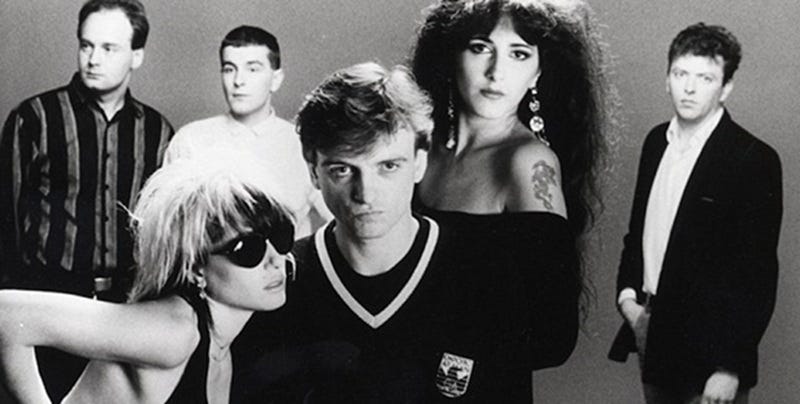
THE BRIX YEARS (1983-1989)
“Tempo House” from Perverted by Language (1983, Rough Trade). This is the first Fall album that Brix appears on, but it’s only on the track “Hotel Bloedel,” so not on this 9-minute epic, one of their longest and most dragged-out dirges, notable for being in a relatively major key, and for having very little guitar (perhaps even none?), Scanlon mostly just supplying an excellent doubled vocal on the chorus. It is a Mark Smith/Steve Hanley co-write, and truly that’s about all we have here, a typically relentless Steve Hanley engine-room bass line, pushed with rhythmic extrapolation from the Karl Burns/Paul Hanley double drummer corps, and vocal/lyrical extrapolation from the relentless Smith (who also plays some extremely sparse and very mental keyboard noise stabs — watch the video linked just ahead). He begins the tale thus: “A serious man, in need of a definitive job/He had drunk too much mandrake anthrax,” and then the “Pro-rae, pro-rae, oh Loron . . .” refrain,possibly nonsensical, that haunts the whole song. After that there is an emphatic chorus — “PUT YOUR CLAIM INTO TEMPO HOUSE/GO ROUND THERE AND HAVE A GROUSE” — but it doesn’t completely matter as this is a ritual incantation as much as it is a story, recorded live at the Hacienda in July 1983, a gig that was also filmed, and would you believe you can watch them play the album track live on YouTube? I’d have to research what a “tempo house” actually is, and why one might be putting a “claim into” one as a way to “have a grouse,” but there are quite a few quotable Smith lines here, of course, more of that crypto-factional business such as “God damn the pedantic Welsh” and “the Dutch are weeping in four languages at least.” And just when you think that’s just Mark being his usual silly crypto-factional self, the original Annotated Fall reports that “there are indeed four officially recognized languages in the Netherlands (Dutch, English, Frisian, and Papiamento) and several regional dialects ("at least").”
“Bug Day” from The Wonderful and Frightening World of The Fall (1984, PVC/Beggars Banquet). Another of those slow-burn dirge-tempo long tracks, this one bringing in even more sound FX and dubbed-out noise-scapery, i.e. a whole lot of that sound in between, becoming one of those true avant-garde/experimental/collage tracks that occasionally rear their head in the middle of a Fall album, here coming on the original U.S. version of The Wonderful and Frightening World of The Fall after two of their more poppy/friendly/fun classics, “Slang King” and “No Bulbs.” Now that the “Tempo House” video has entrained me with visual evidence, I can easily hear the Burns/Hanley double drummer corps and how they play off each other and elasticize the beat. (Wonderful and Frightening World is considered by many to be the definitive album of the Brix years — it’s either that or the next one, This Nation’s Saving Grace — and as far as I can tell Frightening is the only full LP of the very classic lineup of Smith, Smith, Scanlon, Hanley, Burns, and Hanley.)
“Gross Chapel - British Grenadiers” from Bend Sinister (1986, Beggars Banquet). And yet another slow-dirge mood piece in the 5-to-7-minute range where Steve Hanley grinds away on engine-room bass which allows the guitars (Brix and the perennial Craig Scanlon) to needle and simmer in brilliant spindly/moody/melodic post-punk fashion, and which allows the drummer (Simon Wolstencroft, on this album starting an 11-year 11-album tenure with the band that continued until 1997) to cook and surge Karl Burns-style with fewer backbeat requirements. This song does have a relatively upbeat and triumphant and even beautifully prog-rockish chorus that remits the dirge. Also major shout-out to that 4-note keyboard hook that pops up in the verses here and there . . . Mark E, Brix, and Simon Rogers are all credited with keyboards so one of them killed it here . . .
“New Big Prinz” from I Am Kurious Oranj (Beggars Banquet, 1988). One of the all-time Fall classics, and being from 1988 perhaps the last great song from that first one-fourth, the golden age of Primal Fall through the Brix Years. And of course this song is particularly notorious for the live performance that same year on the Other Side of Midnight television programme where Tony Wilson refers to cocaine in that ridiculous intro, and then Mark does something that seems important but makes very little sense with his cassette dictaphone before the song starts, and Brix is the prettiest person who ever lived in that stunning green shirt, and as if that wasn’t enough you’ve got some prime rare footage of Marcia Schofield on keyboards, and, oh yeah, the band is killing on this relentless dirge groove.
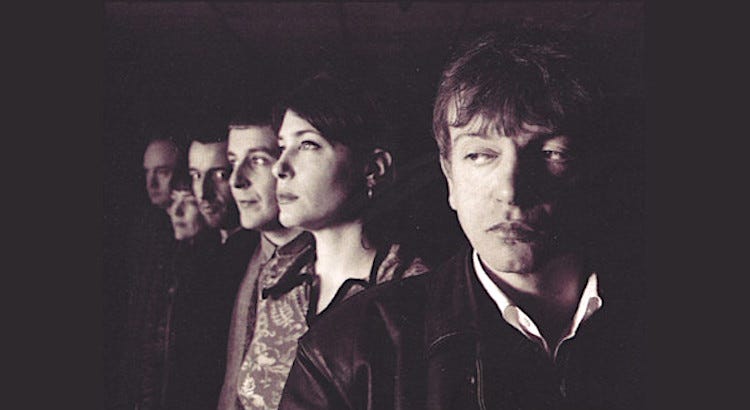
90s INCREASINGLY-TECHNO FALL (THE BUSH/NAGLE YEARS?) (1990-1999)
“Shift-Work” from Shift-Work (1991, Cog Sinister/Fontana). Just one of the most beautiful songs by The Fall, really. I swear to you, after only listening to it once, for the very first time, I was singing the title/chorus/through-hook “shift . . . work . . .” under my breath in that sweet lad falsetto for weeks, not to mention walking around muttering “now now now now now now” like Mark E. does in the final minute, a quintessential example of how musical he could in fact be, even with his extremely limited harmonic range. Mark E. was a true music lover, and in all honesty he was a true musician, and these “now now now”s prove it, as single-note-perfect as Neil Young’s guitar solo in “Cinnamon Girl.” This song is also very powerful lyrically, blending lost-love lament with kitchen-sink drama in a story of a man kept apart from his woman because capitalism requires them to work opposite schedules. “I thought shift-work would work/but it’s good as broken us apart” . . . “shift-work, you let me down/gave me a hard heart/you just cracked my mind/you split us apart” . . . “Raise your wages per year one grand/by shift-work/but I can see me go, go, going from this land/because of shift-work.” Very stripped-down one-guitar no-keyboards lineup of Smith, Scanlon, Hanley, and Wolstencroft.
“Free Range” from Code: Selfish (1992, Fontana). Damn, talk about increasingly-techno 90s Fall, this is super good live-band jamming with electronics, and I’m now realizing that the credit for the whole “increasingly-techno 90s Fall” thing should go to Dave Bush. He’s the only member on Code: Selfish that doesn’t have their own Wikipedia page, but this was his first album in the band on “keyboards, machines,” and he had a huge effect on the band for four years and four albums before being replaced by Julia Nagle for The Light User Syndrome in 1996. As for Mark and the text herein, I love the way he incorporates “Also Spake Zarathustra” into the chorus, and how he sings the last verse with a cool background vocal counterpoint from Cassell Webb (she’s an interesting thread herself, having been a member of Mayo Thompson’s Saddlesore back in 1971!), but I’m not sure what he’s on about with the lyrics: “A life code, 2001, free range/Insect posse will be crushed/Moravia, trouble, Moldavia, Europa/Every second third word/Europa/It pays to talk to no-one no more!” I know he says “second third word” instead of “second third world” but I can’t help but think he might be talking about the people of Eastern European countries such as Moravia and Moldavia as third world “insects.” Or he’s using artistic license to play a character who thinks like that, in order to explore his own inherent crypto-factionalism, duh. As Dave Thompson wrote, “war torn guitars and keyboards cut through with muttered samples, as Smith’s chilling vision of a pan-European society regulated according to the Nazi/Nietzsche-ian ideal was borne out by the near-simultaneous eruption of the war in the Balkans.” Turns out this track was, in a way, The Fall’s biggest hit (?), their “only self-penned Top 40 single” according to Wikipedia, and as long as we’re shouting out Dave Bush, his four album run does coincide with The Fall’s greatest commercial success.
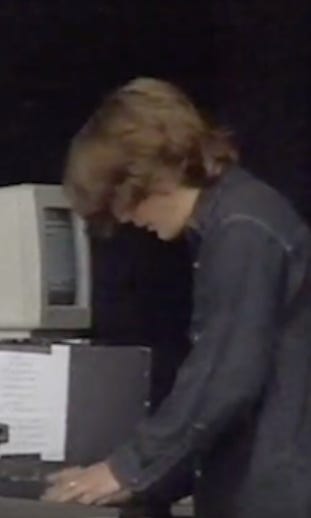
“Lost in Music” from The Infotainment Scam (1993, Matador). I really adore this one, a moody and dreamy cover of a disco classic by Sister Sledge. For all of Mark Smith’s acerbic detachment and inscrutable snidery, he really is a music lover, whether it’s the Can and Captain Beefheart and dub reggae and punk rock that initially inspired The Fall, or his willingness to bring in the “Madchester” sound and its incorporation of soul and disco via the aforementioned Dave Bush. This track always hit me as a deeply romantic ode to the power and majesty of music, but Steve Hanley, who should know, had a different and more ominous spin when he wrote about it at length in The Big Midweek: “The bass lines are a challenge; the funky runs go straight out but the rest remains intact. Behind it, a backing track of sound effects and a dash of house piano. It’s as dancy as The Fall get but, once the vocals are in place, it goes from feeling like the happy disco celebration of the original to something more sinister. Mark’s vocal style, often tending towards the snide, coupled with a savage editing of the original words, results in the emphasis being much more about the trap than the music. The more we hear it, the less it feels like a positive thing. It could be about all of us, doing this because we don’t know anything else. Having gone too far to turn back, we’re lost in music and he’s lost for words.” It’s also nice to hear Mark speaking some French (“l’argent est sur la table” — maybe he’d been screening a Bresson film or two?), and quick shout-out to The Infotainment Scam in general, hands down my favorite 1990s Fall album, having bought it very cheaply on vinyl and spinning it all the time back then. So many bangers: “Glam-Racket,” of course; another moody/dreamy/unlikely cover in “I’m Going to Spain”; “It’s a Curse” with that haunting “operation: mindfuck” lyric, not to mention “I do not like your tone, it has ephemeral whinging aspects”; obviously any track with the title “Paranoia Man in Cheap Sh*t Room” is going to be a banger; “Light/Fireworks” is a very cool experimental closer, etc.
“15 Ways” from Middle Class Revolt (1994, Matador). You can hear the softer 1990s production and playing, the generic college rock of it all, but this is still a great pop number, coulda/shoulda been that massive hit that Steve Hanley wondered why they couldn’t ever achieve. After all, it is another Dave Bush joint (and shout-out to that weird 20-second false-start intro that sounds like a different Dave Bush joint entirely). The lyrics even have a pop-song vibe, Mark doing a straightforward love-song relationship-drama kinda thing, making the sweet/sly moves on a woman who’s dating someone else.
“Don’t Call Me Darling” from Cerebral Caustic (1995, Cog Sinister/Permanent). As I dig deeper into The Fall, I realize they never really released a truly bad album, but that Cerebral Caustic is a pretty solid bottom third (with bad cover art to boot). This song is more garage-y than “15 Ways,” but still has that soft 1990s production. Definitely mediocre Fall . . . but you know, it’s still pretty good. The band always kills it, and this was the album on which Brix made her unlikely return to the band, doing a great whisper-to-scream gang-moll second-vocal on this track, a bit of post-divorce role-playing therapy.
“The Mixer” live on VH1 Take It To The Bridge programme, June 1996. One more from Brix’s 1990s return, and bookending the 1988 “New Big Prinz” clip posted above, this is the other great Fall-with-Brix television performance (albeit here uploaded with terrible audio). This happened eight years later in June of 1996, just before her second and final departure, and the venue was the VH1 UK program called Take It To The Bridge. They performed “Powder Keg” from the then-current album The Light User Syndrome, but preceded it with a track from all the way back in 1991, “The Mixer” from the Shift-Work LP, giving it an absolutely sublime re-arrangement that runs circles around the original studio version. The violin part has been transposed very nicely to Julia Nagle’s melodica (nodding to UK punk’s great understanding and appreciation of reggae music, particularly Augustus Pablo), and Brix is just killing it on heavy-wrist-action 12-string acoustic guitar overdrive. And of course there’s Mark, singing this haunting and delicate song very well, and once again doing something inscrutable at the beginning with a dictaphone.
“The Ballard of J. Drummer” from The Light User Syndrome (1996, Jet Records). Another album I had not stepped to yet, and it’s hard to say that this a representative selection, as it’s some sort of cinematic Western tale about how “Johnny Drummer” comes to town, complete with a performative/programmatic marching-band drum-roll that is played by either Simon Wolstencroft or Karl Burns. The Annotated Fall suggests that the song is in fact an ode to Karl Burns, and how he held true to good old trap-set rock drumming in the face of the increasingly-techno/rave 1990s.
“Scareball” from Levitate (Expanded Reissue) (1998, released 2018, Cherry Red). Nice little “ba-ba-ba-ba” hook, windy little garage-rock number, great background vocal counterpoint from Julia Nagle, fuck it, another great song. Released as a non-LP extra track on a February 1998 CD single for the song “Masquerade,” which was from the 1997 album Levitate, the last album on which both Steve Hanley and Karl Burns ever played, before both being notoriously fired during the subsequent U.S. tour, onstage at Brownie’s in New York City on April 7, 1998.
“Ol’ Gang” from Levitate (1997, Artful Records) and “Ol’ Gang (live)” from “Masquerade” (CD single 2) (1997, Artful Records). This song is a nutzoid kraut jammer where the vocals don’t kick in until well over halfway through, the band grinding away on an expansive garage-prog-psych chord progression. I like the live version, also from the 1998 “Masquerade” double (!) CD single as well as the expanded Levitate reissue from 2018, the way Mark counts it off with a sneak-preview of his “I was walkin’ down the street just the other night” lyrical trope, and how the overdubbed atonal keyboards and electronics from the album version are deemphasized so it can be all about that cosmic heavy garage riff, as played on guitar here by . . . I’m not sure, actually. The credits aren’t clear. Damon Gough from Badly Drawn Boy? Possibly Mark E. Smith himself? It’s really good psych/punk guitar playing.
“Shake-Off” from The Marshall Suite (1999, Artful Records). This song is nuts, Mark going off about “strong pot” and “eyeball-injecting” and “microplastering,” whatever that might be, over relentless club/jungle/drum&bass and a barked “SHAKE OFF” refrain. From the Marshall Suite album, released 1999, another stone completely unturned by me until right now. This could be the culmination of increasingly-techno 90s Fall. Julia Nagle is on keyboards and possibly the primary musical director. I’m realizing that if 83-89 are the Brix years and 2000-2017 are the Elena years, then maybe, just maybe 90-99 should be the Bush/Nagle years (Bush was 1991-1995 and Nagle was 1995-2002).
21st CENTURY FALL aka THE ELENA YEARS (2000-2017)
“Bourgeois Town” from Live At The Garage - London - 20 April 2002 (released 2007, Hip Priest). An excellent example of leaving no stone unturned when it comes to The Fall, this is from a scorching April 20, 2002 live gig with the quite anonymous and transitional lineup of Ben Pritchard on guitar, Jim Watts on bass, and Dave Milner on drums. This was just a few months before Elena Poulou joined on keyboards in September (and recorded The Real New Fall Album aka Country on the Click in December, the actual start to these so-called Elena Years). The band, whoever they are, is just crushing here on a bone-heavy E-to-G bone-riff, actually a cover of the Leadbelly song “The Bourgeois Blues” that had appeared on the previous 2001 studio album Are You Are Missing Winner? That recording also had Pritchard on guitar and Watts on bass, but the drummer was Spencer Birtwistle, who had left the band before this live gig but then returned for one more studio album, Fall Heads Roll (2005), before he and the entire band except Poulou notoriously walked out in the middle of a United States tour in 2006.
“Mountain Energei” from The Real New Fall LP (Formerly Country on the Click) (2004, Narnack) and live at Øyafestivalen (Oslo), August 11th, 2006. And here’s one from The Real New Fall LP, perhaps the definitive track when it comes to 21st Century Poulou-era Fall. I really only say that because of bumping across a YouTube of the band playing a crushing version of the song live at some Euro festival, which was my introduction to the Elena years and my first realization that all eras of The Fall were completely worthwhile. The song also has that geologic Druidic undertow, apparent in the title itself, again a riff on the purity of “water flowing down the mountain” encroached upon by suburbia and capitalist growth percentages (“Mr Blairstowe and Mr Partridge, they said to me/‘To get a mortgage, you need an income lid’/I THOUGHT IT WAS FREE”). Again The Fall, no matter the lineup, are adept at piledriving and entrancing a simple dirge-riff; as one of the YouTube commenters says (original syntax preserved), “The slow, but eventualy real, realization of the audience, that Mark E. and The mighty Fall had hypnotized them.” And yes, the live version linked above is better than this original studio version. I find the production of The Real New Fall LP to be disappointing throughout, but it’s also a completely different lineup, Smith/Poulou/Pritchard/Watts/Milner, while the live version above took place just 4 months after that band’s aforementioned mass walk-out and features the emergency-replacement lineup of Americans, “the dudes” as Smith and Poulou affectionately called them: Tim Presley on guitar, Rob Barbato on bass, and Orpheo McCord on drums, who were in a Los Angeles band together called Darker My Love and ready to get in the van.
“Get Out - Early Rough Mix” from Reformation! Post-TLC (Expanded Edition) (from 2007, released 2020, Cherry Red). Being originally released in 2007, Reformation! Post-TLC was certainly an album I had written off and knew nothing about, but damn this instrumental demo kicks super hard, and once again the credit should go to “the dudes,” Presley/Barbato/McCord. Reformation! Post-TLC was the only album they made with The Fall, and it is a late-period gem. On this outtake, we have a drum machine + live drums combo, raw electric guitar, disgustingly lardacious synth (?) bass, and no Mark E. Smith at all . . . although he does appear to have the sole writing credit. That is one thing you learn from listening to Steve & Paul Hanley’s essential Oh! Brother podcast: Mark was inconsistent with the writing credits. To paraphrase Steve, sometimes you had nothing to do with the song and still got a credit, other times you completely co-wrote it and didn’t get a credit at all. There is no other song in The Fall discography called “Get Out,” so I think this is an instrumental demo that stayed that way and never got lyrics.
“Victrola Time” from Re-Mit (2013, Cherry Red). Another total kraut jammer, rhythm section fully locked-in motorik-style (David Spurr on bass and Keiron Melling on drums), with a grotesque and ominous synth melody/riff winding through (Elena Poulou on keyboards and Peter Greenway on guitar). The band is great, from 2013, who knew? As it turns out, Greenway, Spurr & Melling, along with Poulou, were the most stable Fall core after the Scanlon & Hanley core departed, staying with The Fall for essentially 10 years from 2007 until Smith’s death in 2017 . . . as Wikipedia points out, this Re-Mit album “marks the first time in the history of the Fall that the group have released four consecutive studio albums recorded with the same line-up.” As for “Victrola Time,” your mileage may vary on the way Smith dives right in with a high-pitched squeal of an old-crone vocalization, but at least he’s pushing into new territory. None of his lyrics or hooks here stand out in particular, but it’s still a wild vocal performance, with a lot of vocal overdubbing and counterpoint — “No Respects Rev.” is another track from this album where the band just kills it garage-style and Mark growls and shapeshifts his way into a frenzied final-chorus final-boss ad-lib/overdub monster movie climax.
“Quit iPhone” from Sub-Lingual Tablet (2015, Cherry Red). From the 30th and penultimate Fall album, released in 2015, and recorded by the increasingly stalwart core of Smith, Poulou, Greenway, Spurr, and Melling, but with a return to the Burns/Hanley-style double-drummer corps via the addition of a second drummer named Daren Garratt. This is the album closer and it’s a wild rant, Smith continuing with the same concerns about technology that we first mentioned here regarding “Psykick Dance Hall” as far back as 1979. Imagine what Mark would think of us today, wandering around trapped in this 2026 virtual hellscape that is the Metaverse. The original Annotated Fall says this about the lyrics, but it works as a summary of the entire Mark Smith aesthetic: “Thanks to Thop Daverty from the Fall Online Forum for transcribing. He admits uncertainty about much of this, and I can scarcely do better...The lyrics occupy a twilit zone between words and scatting. The effect is transfixing in a particular way that one can only imagine Mark E. Smith pulling off: that mixture of humor, rage, message, anti-message, sense, and nonsense which has been, in one form or another, the signature of Fall music for four decades.”
“Couples vs. Jobless Mid 30’s” from New Facts Emerge (2017, Cherry Red). This is it, the 31st and final album by The Fall, released on July 28th, 2017, six months before Mark E. Smith passed away on January 24, 2018. It was also the first Fall album since 2001 without Elena Poulou in the band; she ended their marriage and left the band in 2016. Their last gigs were in November of 2017, with their very last public appearance on November 29 in Bristol, when Smith was too unwell to appear and the remaining members took the stage only to apologize for the cancellation. There are photos from another of those final November performances at thefall.org, with Poulou’s replacement Michael Clapham on keyboards and Smith performing in a wheelchair (and, perhaps even more disconcertingly, wearing a goatee). Mark’s disturbing psychic prescience was haunting the band right until the end, as the album featured a song called “Victoria Train Station Massacre” that was completed and sequenced and announced, artwork having already been sent to the printers, just one week before the Ariana Grande concert bombing on May 22nd, 2017, which occurred in a foyer connecting Manchester Arena to the Manchester Victoria train station and killed 22 people and injured over 1,000. That song is less than 2 minutes long, a truncated bit of not-very-much, while this one runs almost 9 minutes, a grotesque collection of various lumbering bone-dirge bass riffs and keyboard/electronic noise over which Mark rants and growls and cross-overdubs his way through a dark and delirious kitchen-sink horror sequel to “Shift-Work”: “His grin is elf/Makes 10 copies/To his mother spouse/She tortures him in big house/Don’t forget that/Birthday/Look at me, kids/Is irrelevant to your latent sex/and shock your lizard/(Heigh Ho, Heigh Ho) . . .”
CLOSING REMARKS FROM “COLIN”
Well, we have to stop somewhere, even though we’ve still only scratched the vast surface. Let’s give the last word to former Fall roadie Colin Burns, summing up the hypnotic entrancing magic that The Fall always seemed to bring, and that we’ve encountered time and time again during this random sampling. (Those who have read Steve Hanley’s essential memoir The Big Midweek will likely remember Colin, especially due to the endlessly charming license that co-authors Hanley and Olivia Piekarski take in transcribing his accent, but also because of how good he was at his job when working with The Fall. You can get to know him a bit more here.)
“Tonight, you guys blinded me so badly my retinas are still on fire. Ah’ve toured with so many baaands and no one is remotely touching you lot. And ah’ll tell you exactly why. All my life ah have prided myself on being able to look at the stage and to instantly know which of the musicians ah am seeing is playing the various things that ah am hearing. When ah was younger my nan who was a music teacher believed this ability as the first signs that ah had perfect pitch. But with you guys, ah’ve been noticing this for a while now, but ah ain’t said naffin in case you all think ah’ve gone completely whacko-ed, but ah’m telling you, ah hear extra things for which ah can find no physical point of origin on the stage. It is as if occult entities or beings from another dimension are trying to harmonize with you. Believe me, sounds come from that stage that are doubtless being generated in another universe . . . Mark, it wouldn’t surprise me in the slightest if he’s psychic. Ah think, now bear with me, ah really think he’s got The Power. And when he’s on stage with you guys and you’re just so on it, ah’m beginning to believe this power of his is strong enough to overcome local temporal reality as we know it.”
Thanks of course to Mark E. Smith and all 65 of the other members who have passed through The Fall; special shout-out to the person or people who made the original Annotated Fall website, now holding on at archive.org, and also to those behind a new attempt that isn’t well-annotated but at least has all the lyrics.